
 Hong Kong
 China
China
 India
India
 Korea
Korea
 Vietnam
 Singapore
 Kazakhstan
 Israel
 Qatar
Qatar
 UAE
UAE
 Germany
 Netherlands
 Austria
 Poland
 Kenya
Kenya
 Rwanda
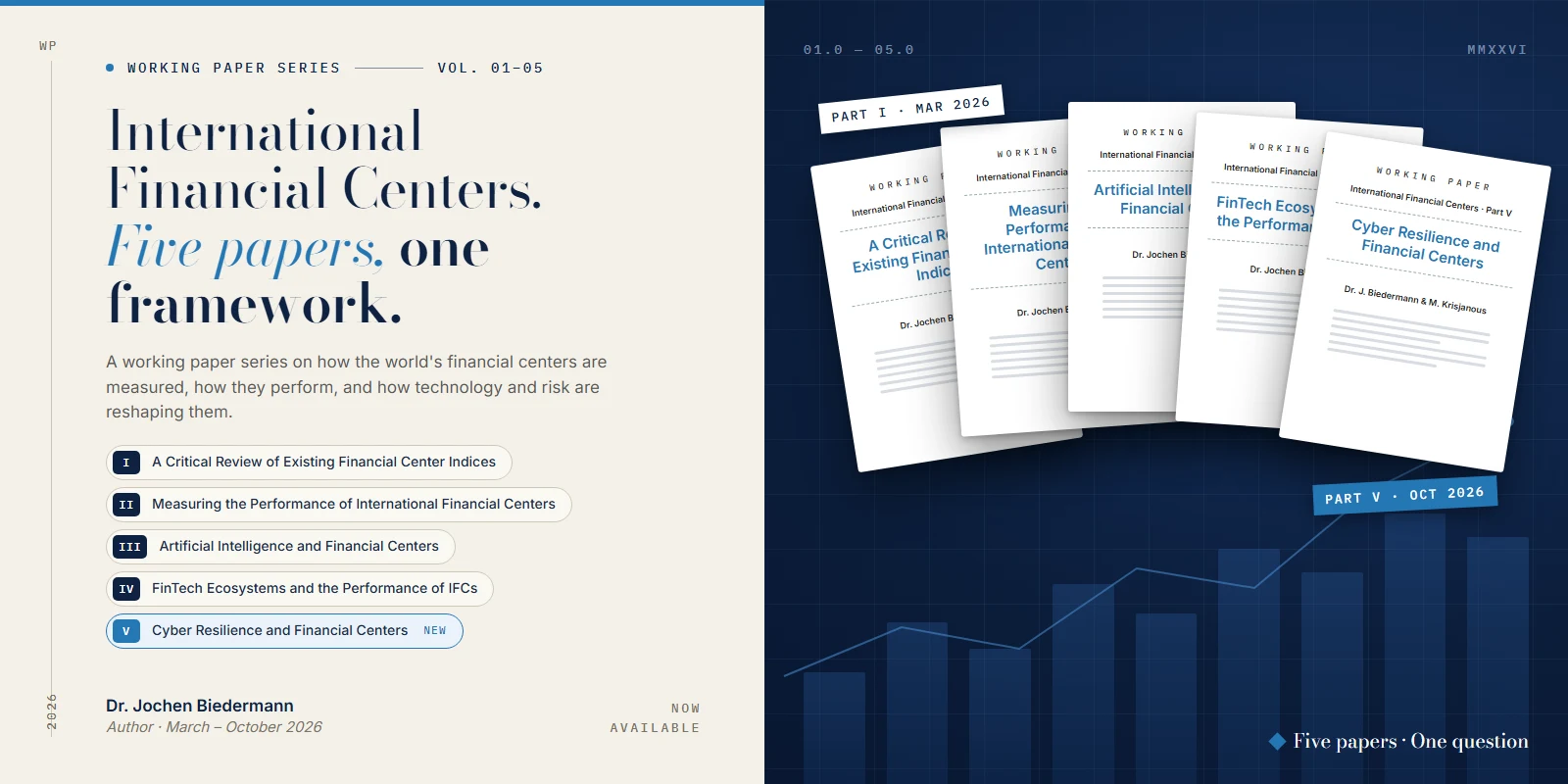
International Financial Centers: A Working Paper Series in Five Parts
14.10.2026
How do you know whether a financial center is actually doing well? Rankings appear every few months, and each one tells a slightly different story. Most of them measure how attractive a center looks — its regulation, infrastructure and talent, often through surveys of market participants — rather than what it actually does for its economy and the world.
Since March 2026, our Managing Partner Dr. Jochen Biedermann has been working through that question in a series of working papers on international financial centers. With the publication of the fifth paper, on cyber resilience, in October 2026, the series now forms a coherent whole: a critique of how financial centers are measured today, a framework for measuring them better, and three applications of that framework to the forces reshaping financial centers right now.
All five papers are freely available on financial-centers.org.
Part I — A Critical Review of Existing Financial Center Indices
March 2026 · Read the paper
The series starts with the existing yardsticks. The paper reviews the major financial center indices — including the Global Financial Centres Index, OFEX, GPCI-FC, NYU Abu Dhabi's FCCI, the New Financial IFC Index and the EU Financial Centres Power Index — as well as several supplementary and discontinued measures. For each, it examines history, methodology, coverage, strengths and weaknesses, compares their latest top-20 rankings, and scores how well each one captures financial center performance and how useful it is for policy and investment decisions. It closes with a blueprint for a next-generation index that addresses the gaps the existing ones leave: green finance, digital finance, city boundary definitions and emerging-market centers.
Part II — Measuring the Performance of International Financial Centers
April 2026 · Read the paper
The core of the series. Existing frameworks mainly measure enabling conditions; they explain why a center is attractive but say little about what it actually does. Part II proposes a functional approach built on four core dimensions — domestic impact, international contribution, international connectivity and attractiveness — complemented by three factors that amplify and protect performance: innovation capacity, reputation and trust, and resilience. It adds a diagnostic dashboard for self-assessment and a four-stage typology of financial centers. The framework is explicitly designed as a diagnostic and strategic tool, not as yet another ranking.
Part III — Artificial Intelligence and Financial Centers
May 2026 · Read the paper
Part III applies the framework to AI and finds that AI touches every dimension of it, not just innovation: AI governance is becoming part of regulatory quality, AI infrastructure is becoming part of connectivity, and AI-specific risks such as third-party concentration and market correlation belong in resilience measurement. The paper proposes a seven-dimension indicator framework for AI ecosystem performance, reviews five strategic choices facing financial center leaders, and concludes that AI works best as an "integration layer" that raises the value of everything else a financial center does.
Part IV — FinTech Ecosystems and the Performance of International Financial Centers
June 2026 · Read the paper
The fourth paper turns to a subject close to our own work at FinTech Consult: how the strength of a FinTech ecosystem affects the performance of the financial center around it. It argues that no single index or composite KPI can capture FinTech ecosystem performance and that a multi-dimensional diagnostic approach is needed. Its central finding is that the FinTech ecosystem influences every dimension of the performance framework — most strongly innovation capacity, and most often underestimated in its effect on resilience. The paper ends with nine practical recommendations for financial center leaders, regulators and industry associations.
Part V — Cyber Resilience and Financial Centers (new)
October 2026 · with Marc Krisjanous · Read the paper
The latest paper, co-authored with Marc Krisjanous, takes on cyber risk. Cybersecurity has been a supervisory topic for about a decade, but today's rules mostly bind financial institutions — and rarely reach the vendors, technology providers and small licensees through which many serious incidents now arrive. Points of failure have shifted towards wallet providers, payments connectivity vendors and post-trade platforms; EU and UK oversight of critical ICT third parties covers the largest providers but not the long tail behind them; and AI mainly makes familiar attacks cheaper, which, combined with dependence on a few model and cloud providers, turns systemic risk into a question of asymmetry and concentration.
Because losses from major incidents are shared, the paper argues, "the defense must be collective too" — and that is where financial centers can add value without becoming supervisors. It proposes seven practical functions for financial center organizations, from mapping shared dependencies to coordinating cross-firm exercises and helping smaller firms raise their standards, and closes with a nine-dimension resilience maturity model that measures each center against its own progress rather than ranking centers against each other.
One thread through all five
Read together, the papers make one argument: financial centers should be assessed by what they do — for their domestic economy, for international finance, and in how well they withstand shocks — rather than by how they are perceived, and they should be assessed in a way that helps them improve rather than simply placing them on a league table. Parts III to V then show what that means in practice for the three forces we see shaping financial centers most: artificial intelligence, FinTech, and cyber risk.
For FinTech companies, the series offers a useful lens on the markets we cover. The strength of a city's FinTech ecosystem is not a side story to its financial center — it feeds directly into its innovation capacity, connectivity and resilience. That is one reason we track FinTech ecosystems city by city, from Germany and Hong Kong to Singapore, Qatar and Rwanda.
Earlier work by Jochen Biedermann on financial centers includes How to make a financial center thrive and the papers on stablecoins and financial centers. The papers reflect the author's personal views. For more on financial centers, including the weekly Financial Center News newsletter, visit financial-centers.org.